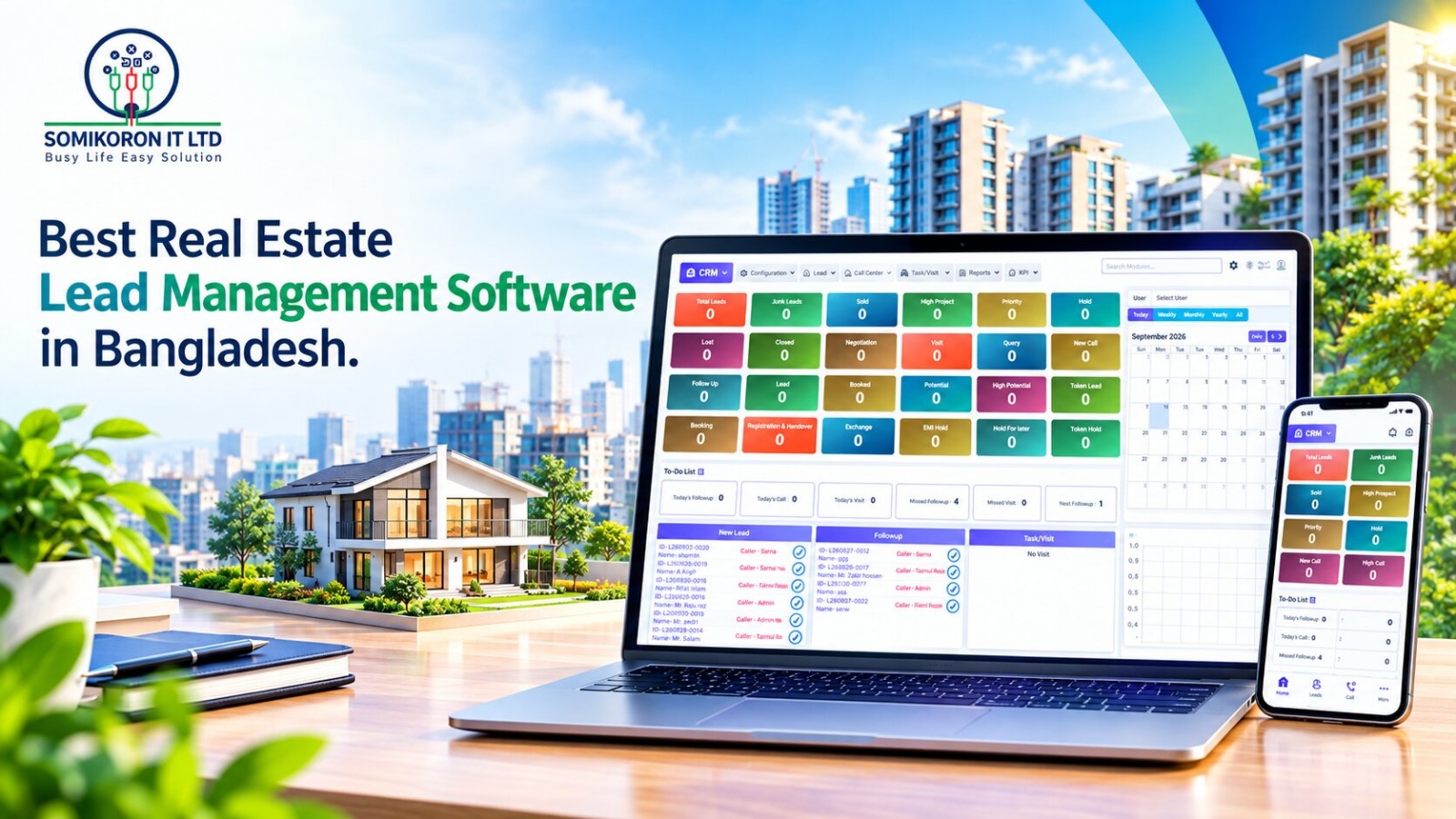
Best Real Estate Lead Management Software in Bangladesh 2026
Best Real Estate Lead Management Software in Bangladesh 2026
A real estate developer can generate hundreds of inquiries every month—but generating leads is only the beginning.Many sales teams in Bangladesh still manage leads through spreadsheets, paper notes, phone calls, WhatsApp conversations, or Facebook Messenger inboxes. As the number of inquiries grows, some leads get missed, follow-ups are delayed, and sales managers lose visibility into which prospects are ready for a site visit, negotiation, or booking. This is where real estate lead management software becomes essential.A modern CRM gives sales teams a centralized system to capture leads, organize customer information, schedule follow-ups, track sales activities, monitor the pipeline, and measure conversions. However, not every CRM is designed around the unique requirements of real estate businesses. For property developers, a CRM should do more than store contact information. It should support the complete journey from lead generation to customer conversion while giving management a clear view of sales performance.
Quick Answer:What Is the Best Real Estate Lead Management Software in Bangladesh?
Somikoron CRM is a strong choice for real estate businesses in Bangladesh looking for a centralized platform to manage leads, customer interactions, sales activities, follow-ups, and business data.Somikoron's CRM solution includes lead management, customer and account management, sales and opportunity management, task and activity management, workflow automation, notifications, reporting, and integration capabilities.For real estate developers that need more than a standalone CRM, Somikoron's broader business and project management ecosystem can connect CRM activities with areas such as accounting, finance, project management, inventory, and other business operations.
Other platforms—including PinCRM by PinTechERP, REVE Systems, Zoho CRM, and HubSpot CRM—may also be worth considering depending on your business requirements, customization needs, marketing strategy, team size, and existing software environment.
What Makes Lead Management Software “Real Estate-Specific”?
A generic CRM primarily manages contacts, conversations, tasks, and sales opportunities. A real estate-specific CRM needs to go further. Property sales often involve multiple projects, customer inquiries, site visits, negotiations, quotations, unit availability, bookings, payments, installments, and long sales cycles. A suitable system should help sales teams connect these activities instead of managing them separately.
For a real estate company in Bangladesh, important capabilities include:
◼️ Lead capture and source tracking from digital campaigns, websites, referrals, walk-ins, and other channels
◼️ Lead assignment and segmentation so sales representatives can manage prospects efficiently
◼️ Follow-up scheduling and reminders to reduce missed opportunities
◼️ Sales pipeline management from initial inquiry through conversion
◼️ Task and activity tracking for sales representatives and managers
◼️ Workflow automation for repetitive sales processes
◼️ Real-time reports and dashboards for management
◼️ Integration with accounting and other business systems
◼️ Scalable architecture that can support growing teams and multiple business operations
The objective is simple: turn scattered inquiries into organized sales opportunities and give the sales team a structured path from first contact to successful conversion.
Top Real Estate Lead Management Software in Bangladesh
Easy-to-use CRM with free entry-level features and marketing tools
Cloud
Note: Features, pricing, deployment options, and integrations can vary by plan and implementation. Businesses should confirm current commercial terms directly with each provider before making a purchasing decision.
1.Somikoron CRM—Best Overall Real Estate Lead Management Software in Bangladesh
Somikoron CRM is designed to help businesses manage leads, customer relationships, sales opportunities, activities, and follow-ups from one centralized platform.For real estate companies, this can create a more structured sales process by replacing scattered spreadsheets, manual reminders, and disconnected customer records with a centralized CRM environment.Somikoron's published CRM capabilities include Lead Management, Contact & Account Management, Sales & Opportunity Management, Task & Activity Management, Customer Support, Reports & Analytics, workflow automation, notifications, email/SMS integration, role-based access, and API/third-party integration support.
☑️ Centralized Lead Management
Every potential customer can be organized within a structured lead management system. Sales teams can track prospects throughout their journey instead of relying on separate spreadsheets, notebooks, or individual communication histories. Somikoron CRM's lead management functionality is designed to capture, track, and nurture leads throughout the sales journey.
☑️ Follow-Up Scheduling & Reminders
A lead is valuable only when the sales team follows up at the right time.Somikoron CRM provides task management, activity tracking, notifications, and follow-up capabilities designed to help teams stay on top of pending activities and reduce missed follow-ups.
☑️ Clear Sales Pipeline Visibility
Sales managers need to know what is happening with every prospect—not just how many leads have entered the system. With sales and opportunity management, teams can organize prospects according to their current stage and monitor progress through the sales pipeline. For real estate businesses, this can help management identify:
◾ New inquiries
◾ Active prospects
◾ Follow-up opportunities
◾ High-priority leads
◾ Negotiation-stage customers
◾ Converted customers
☑️ Complete Customer Activity History
A customer relationship often involves multiple calls, meetings, messages, notes, and follow-ups. Somikoron CRM provides customer profiles and activity tracking so teams can maintain a more complete record of customer interactions. This is particularly useful when a lead is transferred from one sales representative to another because the new representative can review the available history before continuing the conversation.
☑️ Workflow & Task Automation
Manual CRM administration can consume valuable sales-team time. Somikoron's CRM includes workflow and task automation capabilities that can automate repetitive activities such as lead assignment, follow-up tasks, and notifications. The result is a more consistent sales process with less dependence on manual reminders.
☑️ Real-Time Reports & Analytics
A sales manager needs more than a list of customer names.Somikoron provides reporting and analytics capabilities that can help businesses monitor sales performance, lead conversion, employee activity, follow-ups, and other business metrics.This gives management a clearer basis for answering questions such as:
◾ How many leads are currently active?
◾ How many leads have been converted?
◾ Which sales representatives are handling the most opportunities?
◾ Which follow-ups are pending?
◾ Where are prospects dropping out of the sales pipeline?
☑️ Integration with Broader Business Operations
One of Somikoron's major advantages is that CRM does not have to operate as an isolated system.Somikoron's broader business management platform includes CRM alongside accounting and finance, inventory, HRM, purchasing, project management, and analytics modules.Its project management solution also positions CRM alongside project, inventory, procurement, accounts, and HRM functions for real estate and construction-related operations.For developers looking to connect customer and sales activities with broader business operations, this integrated approach can reduce data fragmentation.
2.PinCRM by PinTechERP — Best for ERP-Connected Real Estate Operations
PinCRM is positioned as a locally developed CRM solution for real estate businesses in Bangladesh. Its published positioning emphasizes lead management, property-related sales processes, and integration with the wider PinTechERP ecosystem.It can be a suitable option for developers that want CRM functionality closely connected to their broader ERP environment.
Best for: Real estate businesses prioritizing ERP-connected sales and operational workflows.
3.REVE Systems — Best for Digital & Overseas Customer Engagement
REVE Systems is another option businesses may consider when customer engagement, digital communication, and marketing automation are major priorities.For developers targeting customers through digital channels—including overseas or diaspora audiences—marketing automation and conversational tools can be particularly valuable.
Best for: Businesses with a strong focus on digital engagement and overseas customer acquisition.
4.Zoho CRM — Best for Deep Customization
Zoho CRM is a globally established CRM platform known for customization, automation, integrations, and flexible sales workflows. For businesses with complex internal processes, its customization capabilities can be useful. However, a general-purpose CRM may require additional configuration before it fully reflects a real estate company's specific workflow.
Best for: Businesses that prioritize customization and want to build a CRM process around their existing operations.
5.HubSpot CRM — Best for Startups & Small Sales Teams
HubSpot CRM is widely recognized for its accessible CRM platform and marketing ecosystem. It can be a practical starting point for smaller teams that need centralized contact management, sales tracking, and marketing capabilities. HubSpot also provides dedicated CRM solutions and resources for real estate businesses. However, businesses with more complex real estate workflows may eventually require additional configuration, integrations, or paid functionality.
Best for: Startups, small agencies, and teams looking for an easy-to-use CRM ecosystem.
♦️Real Estate Lead Management Software: What Should You Look For?
Before choosing a CRM, real estate companies should evaluate the software against their actual sales process.
1. Lead Capture & Source Tracking - Your CRM should help you understand where leads are coming from. For example: ◾ Facebook campaigns
◾ Website inquiries
◾ Phone calls
◾ Referrals
◾ Walk-ins
◾ Property portals
◾ Marketing campaigns Source-level visibility helps management understand which channels are generating quality opportunities. 2. Follow-Up Management - A good CRM should make it difficult for a sales representative to forget an important follow-up. Look for: ◾ Follow-up reminders
◾ Task assignment
◾ Notifications
◾ Activity tracking
◾ Automated workflows
◾ Missed-follow-up reports
3. Sales Pipeline Management - The CRM should provide a clear picture of where every lead stands. A typical real estate pipeline may include:
New Lead → Contacted → Qualified → Site Visit → Negotiation → Booking → Converted
The exact stages should be configurable according to your company's process.
4. Customer 360° View - Before calling a customer, a sales representative should ideally be able to see the available customer history in one place. This may include: ◾Contact information
◾ Previous conversations
◾ Follow-up history
◾ Meetings
◾ Site visits
◾ Notes
◾ Documents
◾ Sales activities
5. Reporting & Management Dashboard - Management should be able to monitor sales performance without manually collecting reports from individual sales representatives. Important reports can include: ◾ Lead conversion reports
◾ Sales performance
◾ Follow-up reports
◾ Employee activity
◾ Customer interaction history
◾ Campaign performance
◾ Revenue-related reports
6.Integration & Scalability - Your CRM should fit into your broader technology environment. If your company already uses accounting, ERP, project management, inventory, or other business software, integration can help reduce duplicate data entry and fragmented information.
How Much Does Real Estate CRM Software Cost in Bangladesh?
There is no fixed price for Real Estate CRM Software in Bangladesh. The total cost depends on several factors, including the size of your team, required features, customization, deployment, integrations, and support requirements. The main factors that influence CRM software pricing include:
✔️ Number of users: Pricing may vary depending on how many employees or sales representatives will use the CRM.
✔️ Required modules: Features such as Lead Management, Customer Management, Sales, Follow-up, Task Management, Reporting, and Payment Tracking can affect the overall cost.
✔️ Cloud or other deployment requirements: Cloud-based solutions, hosting, server specifications, and deployment requirements can influence pricing.
✔️ Customization: Businesses with unique workflows may require customized features and interfaces.
✔️ Integrations: Integration with websites, email, SMS, social media, accounting systems, or other business applications may add to the cost.
✔️ Automation requirements: Automated follow-ups, notifications, lead assignment, reminders, and workflow automation can affect the overall investment.
✔️ Support and implementation: Training, data migration, implementation, and ongoing technical support may be included or charged separately.
✔️ Reporting requirements: Advanced dashboards, sales reports, lead conversion analytics, and customized reports may require additional development. Some international CRM platforms offer free or entry-level plans, while advanced business solutions may follow per-user, per-module, subscription-based, or customized pricing models. For a real estate developer, the cheapest CRM is not always the most cost-effective option. Instead of focusing only on the software price, businesses should consider the potential return on investment.
How Much Can a Real Estate CRM Save or Generate?
A well-implemented CRM can help businesses reduce missed leads, improve follow-up efficiency, track sales activities, and gain better visibility into lead conversion. The real value comes from understanding:
How much revenue could your business recover by preventing missed leads, improving follow-up, and increasing conversion visibility?
Therefore, businesses should request a customized quotation based on their actual team size, lead volume, required modules, customization needs, and workflow. Choosing the right Real Estate CRM Software in Bangladesh should be based not only on price, but also on usability, scalability, features, support, and the potential business value it can deliver.
How to Choose the Best Real Estate Lead Management Software?
Choosing the right CRM should start with your sales process—not with a feature list. Before making a decision, ask these questions:
✔️ Can it capture and organize leads from multiple sources?
If leads are coming from Facebook, websites, phone calls, referrals, and other channels, your CRM should provide a centralized system.
✔️ Can the sales team manage follow-ups efficiently?
Look for reminders, task assignment, notifications, and workflow automation.
✔️ Can managers see the entire sales pipeline?
Management should be able to identify which leads are new, active, pending, qualified, or converted.
✔️ Can it support your real estate workflow?
The system should be flexible enough to reflect your actual property-sales process.
✔️ Can it integrate with other business functions?
For developers, CRM becomes significantly more valuable when customer and sales data can work alongside accounting, project management, and other operational information.
✔️ Can it scale with your company?
Your CRM should be able to support additional users, projects, leads, workflows, and modules as the business grows.
Frequently Asked Questions
☑️ What is the best real estate lead management software in Bangladesh?
There is no single CRM that is perfect for every company. However, Somikoron CRM is a strong option for Bangladesh-based real estate businesses looking for centralized lead management, sales pipeline tracking, follow-up management, workflow automation, reporting, and broader business-system integration.
☑️ Why do real estate companies need CRM software?
Real estate businesses typically manage large numbers of inquiries, follow-ups, customer interactions, sales opportunities, and transactions. CRM software centralizes this information and helps sales teams manage leads systematically rather than relying on scattered spreadsheets, paper records, or individual employee memory.
☑️ Can CRM software help prevent missed follow-ups?
Yes. CRM platforms can provide task management, reminders, notifications, activity tracking, and workflow automation. These features help sales teams maintain consistent follow-up schedules. Somikoron CRM includes task/activity management, notifications, and workflow automation capabilities.
☑️ Can a CRM be integrated with accounting and business management software?
Yes. Depending on the platform and implementation, CRM systems can integrate with accounting, ERP, project management, and other business applications. Somikoron's broader business management ecosystem includes CRM alongside accounting, finance, project management, inventory, HRM, and other modules.
☑️ Is Somikoron CRM suitable for real estate developers?
Somikoron offers CRM functionality for lead management, customer management, sales opportunities, activities, automation, reporting, and integrations. Its broader project-management offering also combines CRM with project, accounts, inventory, procurement, and HRM capabilities, making it relevant for businesses managing real estate and construction-related operations.
☑️ Is a free CRM always the best option?
Not necessarily. A free CRM can be useful for small teams and basic lead management. However, growing real estate companies may require advanced automation, customization, reporting, integrations, and industry specific workflows that go beyond basic free features. Stop Losing Real Estate Leads to Missed Follow-Ups .A lead is more than a name and phone number. It represents a potential customer, a potential booking, and ultimately potential revenue for your business. The right CRM can help your sales team capture every inquiry, organize customer information, maintain consistent follow-ups, monitor the sales pipeline, and make better decisions using real-time data. Somikoron CRM brings these capabilities together in a centralized business management environment—helping real estate businesses move from scattered leads to a more organized, measurable, and scalable sales process. If your goal is to improve lead management, reduce missed follow-ups, and gain better visibility across your sales operation, Somikoron CRM can be a strong platform to consider for your real estate business in Bangladesh.
Ready to Transform Your Real Estate Sales Process?
Explore Somikoron CRM and discover how a centralized lead management system can help your sales team manage leads, follow-ups, customer interactions, and sales opportunities more efficiently.
John Doe
Lorem ipsum dolor sit amet, consectetur adipisicing elit, sed do eiusmod tempor
incididunt ut
labore et dolore magna aliqua. Ut enim ad minim veniam, quis nostrud exercitation
ullamco laboris
nisi ut aliquip ex ea commodo consequat.